
Overview
This article lists and summarizes relevant studies, papers, tools, and datasets related to Machine Learning (ML) for data networks. The objective is to tie together the ML capabilities of the Private Island ® open source project with ongoing research and deployments both in industry and academia.
ML Concepts
Nvidia: What is Physical AI?
"Physical AI lets
autonomous systems like cameras, robots, and self-driving cars
perceive, understand, reason, and perform or orchestrate complex
actions in the physical world."
"A SmartNIC (Network
Interface Card) is a specialized type of NIC that offloads certain
network processing tasks from the host CPU."
Surveys / Primers
Primer paper that provides
"an efficient start for anybody doing research regarding machine
learning for networks or using networks for machine learning."
Summary article by a
network giant
Summary of "fundamental
techniques, specific frameworks, and access to relevant datasets"
"This paper explores the
crucial role of AI and ML in enhancing cybersecurity defenses against
increasingly sophisticated cyber threats, while also highlighting the
new vulnerabilities introduced by these technologies. Through a
comprehensive analysis that includes historical trends, technological
evaluations, and predictive modeling, the dual-edged nature of AI and
ML in cybersecurity is examined. Significant challenges such as data
privacy, continuous training of AI models, manipulation risks, and
ethical concerns are addressed."

"Explores the application
of ML in selecting and optimizing cybersecurity models for enterprise
ICT systems"
ML Community / On-line Database
"The platform where the
machine learning community collaborates on models, datasets, and
applications."
"Join over 29M+ machine
learners to share, stress test, and stay up-to-date on all the latest
ML techniques and technologies. Discover a huge repository of
community-published models, data & code for your next project."
"Explore and extend models
from the latest cutting edge research"
ML and Real-Time Interfencing on Ubuntu Linux
"Build enterprise-grade AI
projects with secure and supported Canonical MLOps. Develop on your
Ubuntu workstation using Charmed Kubeflow or Charmed MLFlow and scale
up quickly with open source tooling in every part of your stack."
"Install a well-known model
like DeepSeek R1 or Qwen 2.5 VL with a single command, and get the
silicon-optimized AI engine automatically."
"An end-to-end demo that
will walk you through setting up a scalable model training
environment"
"This blog aims to provide
an in-depth look at Ubuntu AI, covering fundamental concepts, usage
methods, common practices, and best practices."
ML Frameworks
Apache Spark Unified
engine for large-scale data analytics
"Apache Spark is a
multi-language engine for executing data engineering, data science,
and machine learning on single-node machines or clusters."
"OpenVINO is an open-source
toolkit for deploying performant AI solutions in the cloud, on-prem,
and on the edge alike. Develop your applications with both generative
and conventional AI models, coming from the most popular model
frameworks. Convert, optimize, and run inference utilizing the full
potential of Intel hardware."
Network Data Sets for Machine Learning
"A comprehensive dataset
derived from 40 weeks of traffic transmitted by 275,000 active IP
addresses in the CESNET3 network—an ISP network serving approximately
half a million customers daily."
Using ML to Detect & Thwart Denial of Service (DOS) Attacks
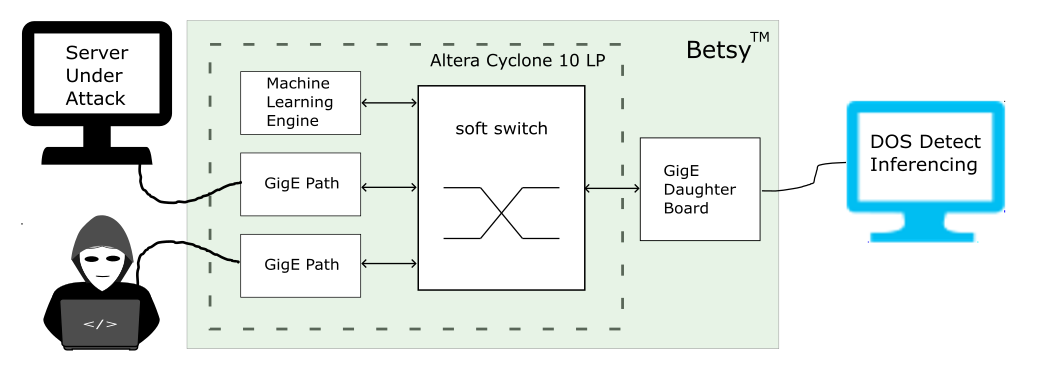
"A mathematical model for
distributed denial-of-service attacks is proposed in this study.
Machine learning algorithms such as Logistic Regression and Naive
Bayes, are used to detect attacks and normal scenarios."
"This study proposes a
machine-learning-based framework to enhance DDoS attack detection and
mitigation, employing Random Forest, XGBoost, and Long Short-Term
Memory (LSTM) models."
"A PCA-based Enhanced
Distributed DDoS Attack Detection (EDAD) framework has been proposed.
Various Machine Learning (ML) algorithms and feature selection
techniques have been used to detect DDoS attacks. Support Vector
Machine (SVM), Logistic Regression (LR), Random Forest (RF),
K-Nearest Neighbours (KNN), Decision Tree (DT) supervised models, and
Principle Component Analysis (PCA) feature selection method are used
to differentiate between attack and regular traffic."
"Examines the application
of twelve leading Machine Learning (ML) techniques, utilizing the
Pycaret module, to effectively analyze Distributed Denial of Service
(DDoS) attacks."
Contributed by Jacob:
"Distributed denial of
service (DDoS) attacks are a subclass of denial of service (DoS)
attacks. A DDoS attack involves multiple connected online devices,
collectively known as a botnet, which are used to overwhelm a target
website with fake traffic."
"The Denial of Service
(DoS) attack is focused on making a resource (site, application,
server) unavailable for the purpose it was designed. There are many
ways to make a service unavailable for legitimate users by
manipulating network packets, programming, logical, or resources
handling vulnerabilities, among others. If a service receives a very
large number of requests, it may cease to be available to legitimate
users. In the same way, a service may stop if a programming
vulnerability is exploited, or the way the service handles resources
it uses."
"Adversaries may perform
Network Denial of Service (DoS) attacks to degrade or block the
availability of targeted resources to users. Network DoS can be
performed by exhausting the network bandwidth services rely on.
Example resources include specific websites, email services, DNS, and
web-based applications. Adversaries have been observed conducting
network DoS attacks for political purposes and to support other
malicious activities, including distraction, hacktivism, and
extortion"
"Distributed Denial of Service (DDoS) attack is a menace to network
security that aims at exhausting the target networks with malicious
traffic. Although many statistical methods have been designed for
DDoS attack detection, designing a real-time detector with low
computational overhead is still one of the main concerns. On the
other hand, the evaluation of new detection algorithms and techniques
heavily relies on the existence of well-designed datasets."
"In this paper, we first review the existing datasets comprehensively and propose a new taxonomy for DDoS attacks. Secondly, we generate a new dataset, namely CICDDoS2019, which remedies all current shortcomings. Thirdly, using the generated dataset, we propose a new detection and family classification approach based on a set of network flow features. Finally, we provide the most important feature sets to detect different types of DDoS attacks with their corresponding weights..
"In this paper, we first review the existing datasets comprehensively and propose a new taxonomy for DDoS attacks. Secondly, we generate a new dataset, namely CICDDoS2019, which remedies all current shortcomings. Thirdly, using the generated dataset, we propose a new detection and family classification approach based on a set of network flow features. Finally, we provide the most important feature sets to detect different types of DDoS attacks with their corresponding weights..
"In this project, the
machine learning-based model was proposed to detect DDoS attacks. The
proposed model used the DDoS-CICIDS2017 dataset with 79 features, and
applied four algorithms: Logistic Regression (LR), Support Vector
Machine (SVM) with different kernels, Random Forest (RF), and
Gradient Boosting (GB). The results highlight the outstanding
performance of the Random Forest model, achieving an exceptional
99.99% accuracy, precision, recall, and F1 Score. Notably, this model
demonstrated a perfect precision of 100.00%, underscoring its
efficacy in accurately classifying DDoS traffic and solidifying its
role as a formidable defense against these cyber threats."


